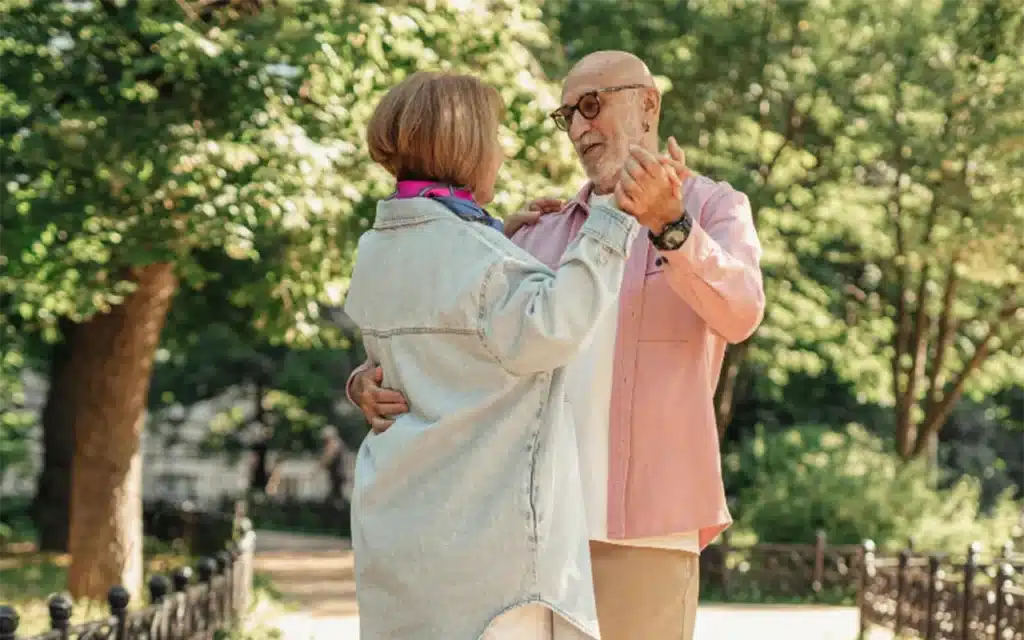
Though she entered the system alone and without a voice, Lynn’s story became one of connection, love, and a firecracker spirit that refused to dim.
Lynn’s story begins the way too many do, without clarity and without anyone to speak for her.
She was found alone, confused, and disoriented outside of a hospital, with no clear record of who she was or where she had come from. By the time Lynn entered the system, her dementia had already progressed to the point where she could no longer reliably share the details of her own life.
When Betsy Frye, her PGS Care Manager, was assigned to her care, much of Lynn’s story was still a mystery.
Her medical certificate revealed a history of repeated hospitalizations and psychiatric stays marked by confusion and cognitive decline, with no surrogate decision-maker. Although she could feed herself, she required full support.
It was believed Lynn had four adult children, but the only confirmed contact Betsy reached was an adult daughter who, when called, told her, “Call me when she’s dead,” and hung up.
Under Betsy’s care, pieces of her story began to come together. With treatment, there were subtle signs of improvement. But it wasn’t until Lynn transferred to a rehab facility that more of her personality began to emerge. Betsy remembers how emotional she was.
“I spent a lot of time with her, holding her hand while she cried. It wasn’t necessarily sadness. It was the confusion.”
Over time, with stable housing, good food, and opportunities to engage with others, Lynn began to bloom. She even found love.
“She was a firecracker,” Betsy remembers with a smile.
Lynn was in great shape. You’d often find her showing off high kicks and asking Betsy to feel her muscles. She was proud of herself. Betsy couldn’t help but wonder if she’d been a dancer in her past.
After being transferred to a long-term care facility, Lynn formed a deep attachment with another resident. The two, affectionately called “Barbie and Ken,” were inseparable.
Lynn often spoke about marrying him. Betsy leaned into it, bringing her bridal magazines so she could flip through and plan her big day.
“She’d forget what she was doing 10 minutes later,” Betsy laughs, “and then pick up again and be excited.”
Lynn thrived in that environment. Staff embraced her personality — cheering on her dancing, engaging her love of music, and supporting her connection with others. And, at the center, was her Barbie and Ken romance.
“They did everything together,” Betsy recalls. “It was more than just being a couple. If one wanted to do an activity, the other one had to say they were going too.”
But Lynn’s life was far from a fairytale. No one came looking for her, no family or friends. Fragments of memory surfaced from time to time. She spoke about her fear of dying in a nursing home and dreamed of living somewhere quiet, in a house with a dog. There was a longing there, whether fully remembered or not.
During her time in care, Lynn showed a natural instinct for helping others. She’d refill cups and gravitate toward medication charts. The signs suggested she may have once cared for others herself.
Then her health took a sudden turn.
After a serious fall, Lynn suffered a compression fracture in her spine. Scans revealed that cancer had spread throughout her spine and, from there, everything moved quickly.
Her condition declined rapidly. She was in and out of hospitals, facing infection after infection: pneumonia, COVID, and other complications that made treatment increasingly difficult.
Like so much of her life, when things reached their most critical point, there were no clear answers about what she would have wanted.
With no clear directives and no family willing or able to step in, Betsy and her team were left to make the most difficult decisions. Every choice required balancing what was medically appropriate with what was humane. And the most frustrating part, Betsy recalls, was the constant pushback from providers, having to repeatedly explain what it means to serve as a guardian for someone who has no one else.
“When you’re already in a crisis situation, keeping track of all the medical decisions, saying goodbye to someone you formed a relationship with, and then having to argue your case to prove that you care…it’s really frustrating,” Betsy says.
Even in the middle of that, Betsy kept advocating for Lynn’s dignity. Eventually, a new attending physician stepped in, someone who understood the situation and helped move forward with a plan that prioritized Lynn’s comfort.
And in her final days, Betsy stayed close. About 24 hours before Lynn passed, she remained by her side, playing music, holding her hand, stroking her hair, and speaking to her gently.
She told Lynn to look for Betsy’s dad, someone she thought would’ve gotten a kick out of her. She played We’ll Meet Again by Johnny Cash, the same song she played for her own father when he was passing. Betsy played other songs, too. One, a religious piece, brought tears to Lynn’s eyes.
Like she does with all of her clients, Betsy told Lynn it was okay to let go. She told her how grateful she was to have known her and that she’d never forget her.
When a life can’t be traced through years of memories, Betsy creates new ones to send her clients off with. She brought a framed photo of Lynn’s boyfriend so he could be there with her. She recited aloud the moments they’d shared — from the day they met, to goat videos that made her laugh, to the sparkly gold shoes she once wore.
“When my dad was dying, I could tell him all these memories we had,” Betsy says. “I don’t have a lifetime of memories with a client, but I can talk about the memories I do have.”
And for someone who might otherwise be forgotten, Betsy makes sure they leave the world knowing someone is there who cares.
Lynn passed away peacefully with a friend.
Later, during a Public Guardian Services team meeting, Betsy and her colleagues honored the clients they had lost that year. They printed their names, birthdays, and photos. They shared stories and lit a candle. Lynn was among them.
When asked what she took away from her time with Lynn, Betsy says that she taught her:
“It’s never too late. To find love. To be romantic. To be silly. To dance.”
“She was just so proud of herself,” Betsy adds. “And so funny.”